The Software Engineering Institute (SEI) of the Carnegie Mellon University has published several books and papers describing architectural methods for solution architecture. Although the SEI calls it software architecture, the presented methods can be applied to solution engineering in general, including infrastructure architecture.
The SEI does not present an overall methodology that can be followed, but rather provides a set of tools and methods that have proven to work in practice. Some of the methods published by the SEI are:
- Quality Attribute Workshops (QAW) - these workshops use the input of many stakeholders of the system to be developed to define the non-functional requirements of a solution (like performance, availability and security) in a way that makes quality attribute requirements SMART and testable.
- Attribute Driven Design (ADD) - this is an approach to defining a solution architecture in which the design process is based on defined non-functional requirements.
- Views and Beyond (V&B) - this defines how to document an system’s architecture so that others can successfully use it, maintain it, and build a system from it.
- Architecture Trade-off Analysis Method (ATAM) - this is a structured method for analyzing a documented architecture in four one-day workshops.
- Cost Benefit Analysis Method (CBAM) - this method aims at analyzing the financial aspects of architectures. It aims to quantify the financial benefits of a described architecture.
The SEI methods are very useful in infrastructure architecture. Especially the emphasis on non-functional requirements like performance, security and availability is very well in line with the work of an infrastructure architect.
This entry was posted on Friday 21 June 2013
TOGAF stands for The Open Group Architecture Framework. It is an extensive method for establishing (Enterprise) Architectures. TOGAF is one of the few methods not developed by one company (like for instance IAF and DYA that are created by Capgemini and Sogeti respectively).The Open Group consists of a consortium of companies and institutions, developing many standards, including TOGAF.
TOGAF describes three types of architectures:
- Business architecture
- Information Systems architecture, which comprises:
- Data architecture and
- Applications architecture
- Technical architecture
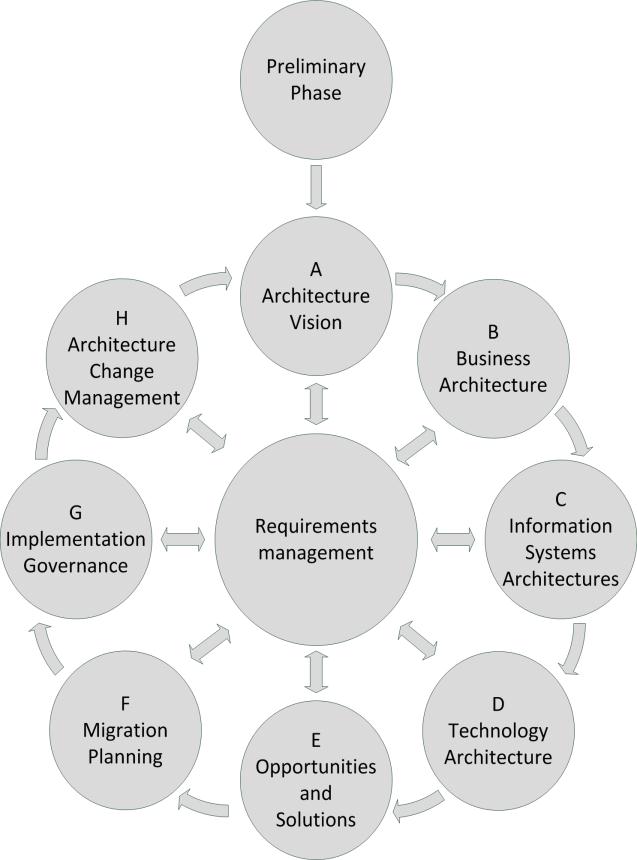
The ADM is the heart of TOGAF. It is an architecture development method.
Figure: TOGAF ADM
The ADM method describes the steps to be taken to come to a complete enterprise architecture or a change to an existing architecture. Every step itself consists of (a large number of) smaller steps.
All steps can be performed sequentially; if in phase H it is concluded that a change of architecture is necessary, the ADM can be re-started from phase A.
It is also possible to use only a part of the ADM (for a particular change or project) or to do all of the ADM, but not all parts in an equally fine grained detail.
TOGAF is an open framework, of which the description can be found on the Internet. TOGAF is also published as a book (700+ pages!) which can be obtained from The Open Group. TOGAF does have a license structure; a fee must be paid if TOGAF is used in a commercial environment. Please check the website of The Open Group for details. For individuals TOGAF can be used under a free license.
TOGAF is an enterprise architecture framework, but it can be useful as a reference in an infrastructure architecture as well. Especially phases D, E and F of the ADM are relevant. Phase D (Technology architecture) is about describing the current and desired architecture and to find the gaps between them. Phase E (Opportunities and Solutions) explains how to create solutions from the desired architecture. And phase F (Migration planning) describes how to determine the projects needed to implement an architecture.
TOGAF also provides examples of architecture principles, stakeholder and requirements management, gap analysis, migration planning techniques and much more, all of them relevant for infrastructure architects.
But be aware that TOGAF is very detailed and complex. It is hard to comprehend and the text can be confusing at some places. Just pick out the parts that are useful in your project.
This entry was posted on Friday 07 June 2013
 English